
Modern port infrastructure—ranging from container terminals to intermodal rail yards—demands ultra-high throughput and minimal latency. High-frequency 60GHz millimeter-wave wireless technology (such as the TNA-305X) delivers fiber-like speeds without the massive cost and disruption of trenching cables. However, 60GHz frequencies face one key challenge: sensitivity to heavy rainfall (rain fade).
Challenge
Rain Fade & Signal Attenuation: During severe rainstorms or intense precipitation, 60GHz radio signals experience sudden attenuation, which can degrade or drop high-frequency point-to-point/point-to-multipoint links.
Operational Risks in Critical Infrastructure: In port logistics, downtime immediately translates to financial loss. Interrupted connectivity between the central command hub and remote terminals (such as container yards or oil & gas facilities) halts automated cranes, security monitoring, and real-time logistics tracking.
Limitations of Manual Intervention: Manual failover systems introduce unacceptable delays, packet loss, and heavy reliance on IT personnel during bad weather events.
Topology
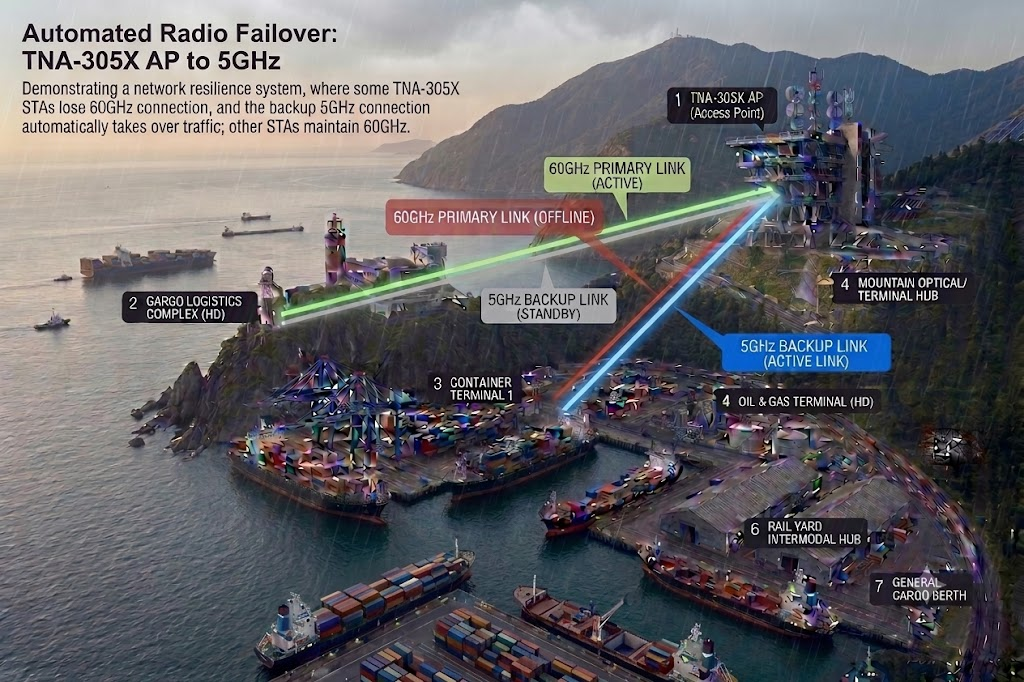
Access Point (TNA-305X AP): Located at the high-elevation point (1 - Mountain Optical / Terminal Hub), broadcasting parallel 60GHz and 5GHz backup signals across the port.
Active 60GHz Primary Link (Green Line): Reaching 2 - Cargo Logistics Complex, where line-of-sight and distance allow maximum throughput via the 60GHz primary channel.
Automated Failover (Red & Blue Lines): At 3 - Container Terminal 1 and 4 - Oil & Gas Terminal, intense precipitation drops the primary 60GHz link (Red Line – Offline). The system instantly shifts active traffic to the 5GHz Backup Link (Blue Line – Active Link)
Solution
The Automated Radio Failover mechanism resolves rain fade by combining high-capacity 60GHz performance with reliable 5GHz fallback:
Simultaneous Dual-Band Monitoring: The TNA-305X AP continuously operates parallel 60GHz (active) and 5GHz (standby) radio lines. Remote client stations (STAs) constantly evaluate signal metrics (RSSI/SNR).
Instantaneous Auto-Switching: When severe precipitation degrades the 60GHz link quality below operational thresholds, traffic seamlessly transitions to the active 5GHz failover link with zero manual intervention.
Automatic Restoration: Once weather conditions improve and 60GHz signal quality normalizes, the system automatically restores traffic to the primary high-throughput 60GHz channel.
Key Resilience Benefits
Extraordinary High Throughput: Delivers multi-gigabit wireless performance during standard operating conditions.
Unmatched Reliability: Eliminates weather-induced downtime by leveraging 5GHz penetrating capabilities during heavy rain.
Flexible Deployment & Reduced OPEX: Enables rapid, cost-effective network deployment across vast industrial areas without laying expensive underground fiber.
Predictable Performance & Easy Management: Provides centralized control and transparent, automated failover management across all port terminals.