
Challenge
As Wireless Internet Service Providers (WISPs) expand into suburban, rural, or mixed-density areas, they often face a challenging last-mile access problem. Traditional wired infrastructure (fiber, DSL) in these areas is frequently either cost-prohibitive or entirely unavailable, and subscriber density is often not high enough to justify large capital infrastructure investments.
Conventional sub-6 GHz (2.4/5 GHz) solutions in these zones commonly run into:
- Interference – congested ISM bands due to numerous neighboring WISP networks, Wi-Fi networks, and other devices, reducing throughput and stability.
- Limited per-subscriber bandwidth – as the number of subscribers on a sector grows, shared channel capacity limits the ability to offer higher-speed services.
- Licensing constraints – some frequency bands require licensing or have strict power limitations.
- Long deployment times – onboarding a new subscriber often requires complex alignment and a lengthy aiming process.
Because the last-mile segment directly determines service quality and subscriber satisfaction, WISPs need a solution capable of delivering high per-subscriber throughput, low interference, and fast, simple installation — even with dozens or hundreds of potential connection points at a single hub site.
Because the last-mile segment directly determines service quality and subscriber satisfaction, WISPs need a solution capable of delivering high per-subscriber throughput, low interference, and fast, simple installation — even with dozens or hundreds of potential connection points at a single hub site.
Topology
At the central (hub) location — a WISP tower, rooftop, or mast structure — a single TNA-303X unit is installed with a beam-steering (scanning) antenna kit configuration, covering a 45° or 90° sector. This unit is connected to the WISP's core network (router/switch), which acts as the DHCP and routing point.
At each subscriber location (residential or business premises), a compact TNA-303L-65 client (Client/STA) unit is mounted, aligned along a line-of-sight (LOS) path to the hub location.
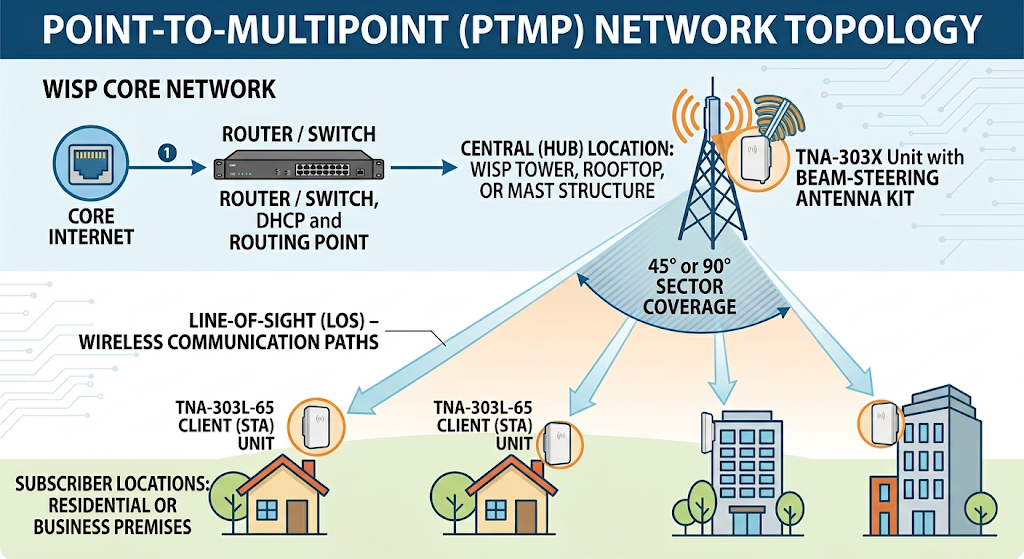
Distances from the hub location to subscribers in this deployment range from a few hundred meters to approximately 2 km, depending on terrain and building density.
Solution
The last-mile access solution is implemented using a TNA-303X unit at the hub location paired with a scanning antenna kit (TNA-AK-S-45 or TNA-AK-S-90), which provides a wide (45° or 90°) horizontal coverage angle while maintaining a high (30 dBi) antenna gain needed for stable connectivity over longer distances. The beam-steering capability allows the hub unit to track and maintain connectivity with each subscriber within the sector, without requiring additional hardware for every new client.
Each subscriber is connected using a TNA-303L-65 — a compact unit with an integrated lens antenna that operates in Client (STA) mode by default. This model is positioned as the most affordable full-band 60 GHz radio on the market, making it ideal for large-scale last-mile deployments where per-subscriber cost efficiency is critical. Alignment is performed via a USB adapter that creates a temporary 2.4 GHz Wi-Fi connection to a mobile device or laptop, significantly shortening on-site installation time.
Before deployment, it is recommended to verify the signal budget for each subscriber link using the Link Budget Calculator — this ensures a sufficient signal margin, accounting for regional rain intensity (rain fade), distance, and in-sector interference.
This solution enables WISP operators to:
- Reduce interference – 60 GHz operates in spectrum unavailable to licensed sub-6 GHz bands, practically eliminating interference from neighboring networks.
- Increase per-subscriber throughput – each hub-to-subscriber link operates as a separate, dedicated channel, delivering up to 1 Gbps of real-world throughput per subscriber without sharing capacity with neighbors on the same sector.
- Accelerate deployment – the compact TNA-303L-65 design and Wi-Fi-based aiming tool allow a new subscriber to be installed quickly, without complex configuration.
- Scale the network efficiently – adding subscribers within a hub sector requires no additional hub-side infrastructure — only a new TNA-303L-65 unit on the subscriber side.
- Ensure stable operation – a properly calculated signal budget combined with the modular TNA-30X family design guarantees reliable performance under varying weather conditions.
As a result, WISP operators gain a fast-to-deploy, high-throughput, low-interference last-mile access solution suitable both for expanding into new territories and for increasing network capacity in densely populated areas.