
Challenge
Modern academic campuses and corporate facilities are outgrowing traditional networking infrastructures. The exponential rise in connected devices, high-definition video streaming, centralized cloud services, and heavy data transfers for academic research has pushed existing networks to their absolute breaking points.
When tasked with interconnecting multiple campus buildings to a central data center, organizations inevitably face three critical roadblocks:
Bandwidth Limitations & High Latency: Legacy copper wiring or outdated outdoor Wi-Fi bridges fail to deliver the throughput required for modern operations. Network congestion leads to dropped VoIP calls, pixelated CCTV security feeds, and frustrating delays when accessing server-side applications or research data.
The High Cost and Disruption of Fiber Trenching: While underground fiber-optic cabling offers high speeds, the reality of deploying it is a logistical nightmare. Trenching through concrete, campus roads, and landscaped green zones requires expensive municipal permits, massive capital expenditure, and months of disruptive construction that paralyzes daily campus life.
Lack of Scalability: Physical cabling makes the network rigid. If a university opens a new temporary laboratory, administrative annex, or dormitory, expanding the fiber network to that new location is a slow, costly, and inefficient process that cannot adapt to dynamic organizational growth.
Core Requirements for the New Infrastructure:
Multi-Gigabit Throughput: Establish a high-capacity backbone capable of handling simultaneous multi-gigabit traffic across all remote buildings.
Rapid, Non-Disruptive Deployment: Deploy the entire multi-building interconnect within days instead of months, completely eliminating the need for ground trenching.
Enterprise-Grade Reliability: Ensure stable, low-latency connectivity for mission-critical applications (CCTV, VoIP, and server access) regardless of weather conditions.
Topology
Solution
The ideal solution is the deployment of a high-capacity 60 GHz Point-to-Multipoint (PtMP) wireless backbone infrastructure. By utilizing advanced millimeter-wave (mmWave) technology, this solution bypasses the need for physical fiber trenching while delivering identical fiber-like speeds, ultra-low latency, and robust reliability directly through the air.
Architectural Breakdown:
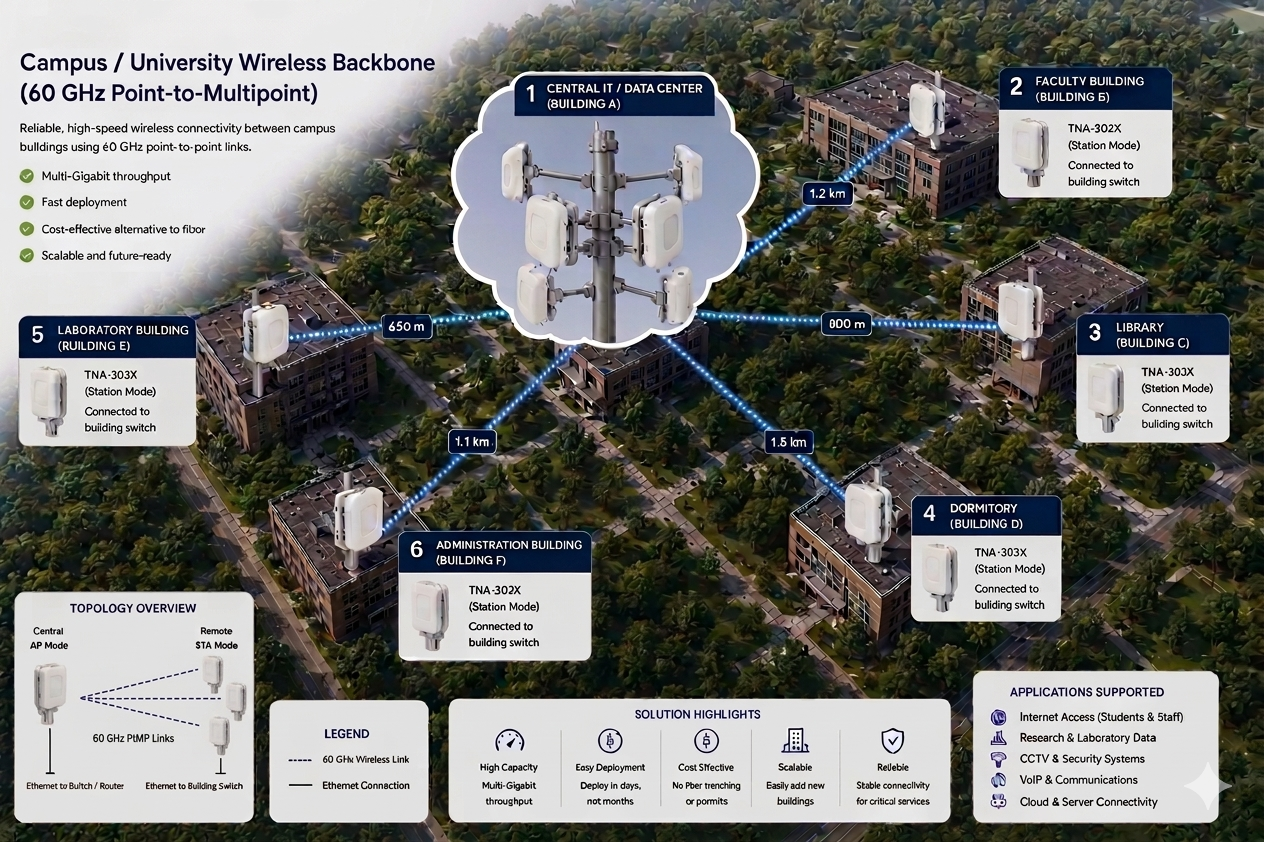
Central Hub (Base Station / AP Mode): A centralized cluster of high-performance TNA-303X units is installed at Building A (Central IT / Data Center). Operating in AP Mode, these sectorial/directional units act as the core distribution node. Directly connected to the main data center switch or router, they manage and allocate multi-gigabit bandwidth out to each corresponding sector of the campus.
Remote Nodes (Station Mode): Matching TNA-303X wireless units are mounted on the rooftops of the outlying buildings—Faculty (Building B), Library (Building C), Dormitory (Building D), Laboratory (Building E), and Administration (Building F). Operating in Station Mode, these units point directly back to their respective AP counterparts at the central hub, establishing seamless, dedicated wireless links over distances ranging from 650m to 1.5km.
Local Distribution: At each remote site, the TNA-303X is connected via a standard Ethernet cable down into the building’s internal network switch, instantly providing high-speed internet and intranet access to all local users and devices.
Key Benefits & Value Delivered:
- Hardware Standardization: Utilizing the versatile TNA-303X across the entire deployment—both as the Central AP and the Remote Stations — drastically simplifies network maintenance, inventory management, and technical training for the IT staff.
- Zero Trenching, Rapid Deployment: The entire multi-building network can be fully deployed and configured in days rather than months, avoiding the massive costs, permits, and campus-wide disruptions associated with digging up asphalt and green spaces.
- All-Weather Enterprise Reliability: Built-in advanced beamforming technology automatically adjusts the wireless links to maintain stable, low-latency connectivity, ensuring that mission-critical services like CCTV Security Systems, VoIP Communications, and Cloud/Server Connectivity remain uninterrupted.
- Future-Ready Scalability: The PtMP architecture is highly flexible. If the campus expands in the future, adding a new building to the network is as simple as installing one additional TNA-303X remote node and aligning it with the central hub, with zero changes required for the underground infrastructure.