
Challenge
Remote solar farm locations are often deployed in areas where traditional internet infrastructure is unavailable or too expensive to install. Energy companies frequently face difficulties establishing reliable connectivity for monitoring, telemetry, security systems, and remote maintenance operations.
Without stable network access, operators have limited visibility into inverter status, power generation metrics, environmental sensors, and fault alerts. This can increase response times, operational costs, and downtime risks.
In many cases, deploying fiber infrastructure across long distances is financially impractical, while LTE/5G coverage may be unstable or insufficient for critical monitoring applications. As renewable energy deployments continue expanding into remote areas, reliable long-range wireless connectivity becomes essential for centralized monitoring and efficient asset management.
Topology
Solution
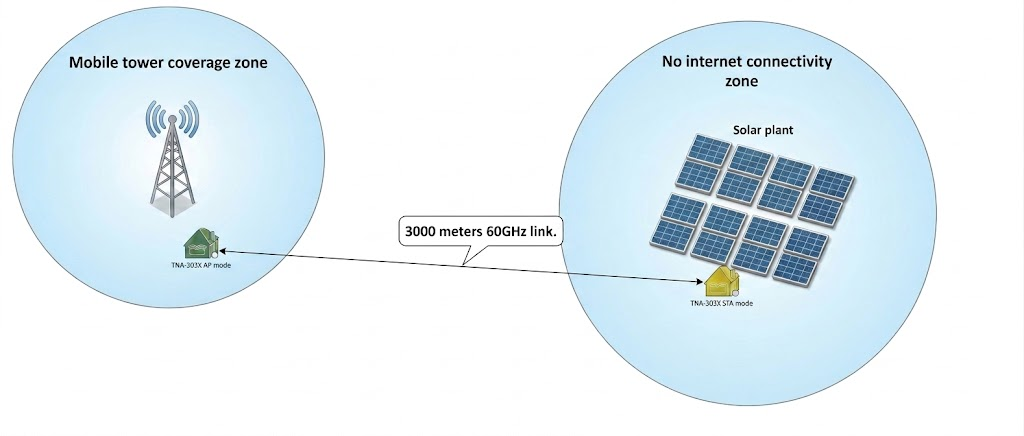
A reliable long-range wireless backhaul can be established using two TNA-303X devices operating over a 60 GHz point-to-point connection.
At the location where mobile network coverage is available, a TNA-303X unit is connected to a router providing LTE/5G internet access and external network connectivity. The router operates as a DHCP server, while the TNA-303X is configured in Access Point (AP) mode.
At the remote solar farm location, where no internet infrastructure is available, a second TNA-303X device is installed and configured in Station (STA) mode. The wireless bridge between both locations enables transparent network connectivity for remote monitoring and management systems.
The distance between the two TNA-303X units is approximately 3000 meters. Based on calculations performed using the Link Budget Calculator, additional AK-150 antennas are recommended to improve signal strength and maintain sufficient signal budget margin for stable long-term operation under varying environmental conditions.
With a reliable connection established between remote locations, energy companies can monitor solar farm performance in real time and proactively respond to incidents, faults, or abnormal operating conditions. This enables improved operational visibility, faster maintenance response, reduced downtime, and more efficient management of renewable energy infrastructure.